2018 Letter to Shareholders

To our shareowners:
Something strange and remarkable has happened over the last 20 years. Take a look at these numbers:
1999 3%
2000 3%
2001 6%
2002 17%
2003 22%
2004 25%
2005 28%
2006 28%
2007 29%
2008 30%
2009 31%
2010 34%
2011 38%
2012 42%
2013 46%
2014 49%
2015 51%
2016 54%
2017 56%
2018 58%
The percentages represent the share of physical gross merchandise sales sold on Amazon by independent third-party sellers – mostly small- and medium-sized businesses – as opposed to Amazon retail’s own first party sales. Third-party sales have grown from 3% of the total to 58%. To put it bluntly:
Third-party sellers are kicking our first party butt. Badly.
And it’s a high bar too because our first-party business has grown dramatically over that period, from $1.6 billion in 1999 to $117 billion this past year. The compound annual growth rate for our first-party business in that time period is 25%. But in that same time, third-party sales have grown from $0.1 billion to $160 billion – a compound annual growth rate of 52%. To provide an external benchmark, eBay’s gross merchandise sales in that period have grown at a compound rate of 20%, from $2.8 billion to $95 billion.
Why did independent sellers do so much better selling on Amazon than they did on eBay? And why were independent sellers able to grow so much faster than Amazon’s own highly organized first-party sales organization? There isn’t one answer, but we do know one extremely important part of the answer:
We helped independent sellers compete against our first-party business by investing in and offering them the very best selling tools we could imagine and build. There are many such tools, including tools that help sellers manage inventory, process payments, track shipments, create reports, and sell across borders – and we’re inventing more every year. But of great importance are Fulfillment by Amazon and the Prime membership program. In combination, these two programs meaningfully improved the customer experience of buying from independent sellers. With the success of these two programs now so well established, it’s difficult for most people to fully appreciate today just how radical those two offerings were at the time we launched them. We invested in both of these programs at significant financial risk and after much internal debate. We had to continue investing significantly over time as we experimented with different ideas and iterations. We could not foresee with certainty what those programs would eventually look like, let alone whether they would succeed, but they were pushed forward with intuition and heart, and nourished with optimism.
Intuition, curiosity, and the power of wandering
From very early on in Amazon’s life, we knew we wanted to create a culture of builders – people who are curious, explorers. They like to invent. Even when they’re experts, they are “fresh” with a beginner’s mind. They see the way we do things as just the way we do things now. A builder’s mentality helps us approach big, hard-to-solve opportunities with a humble conviction that success can come through iteration: invent, launch, reinvent, relaunch, start over, rinse, repeat, again and again. They know the path to success is anything but straight.
Sometimes (often actually) in business, you do know where you’re going, and when you do, you can be efficient. Put in place a plan and execute. In contrast, wandering in business is not efficient … but it’s also not random. It’s guided – by hunch, gut, intuition, curiosity, and powered by a deep conviction that the prize for customers is big enough that it’s worth being a little messy and tangential to find our way there. Wandering is an essential counter-balance to efficiency. You need to employ both. The outsized discoveries – the “non-linear” ones – are highly likely to require wandering.
AWS’s millions of customers range from startups to large enterprises, government entities to nonprofits, each looking to build better solutions for their end users. We spend a lot of time thinking about what those organizations want and what the people inside them – developers, dev managers, ops managers, CIOs, chief digital officers, chief information security officers, etc. – want.
Much of what we build at AWS is based on listening to customers. It’s critical to ask customers what they want, listen carefully to their answers, and figure out a plan to provide it thoughtfully and quickly (speed matters in business!). No business could thrive without that kind of customer obsession. But it’s also not enough. The biggest needle movers will be things that customers don’t know to ask for. We must invent on their behalf. We have to tap into our own inner imagination about what’s possible.
AWS itself – as a whole – is an example. No one asked for AWS. No one. Turns out the world was in fact ready and hungry for an offering like AWS but didn’t know it. We had a hunch, followed our curiosity, took the necessary financial risks, and began building – reworking, experimenting, and iterating countless times as we proceeded.
Within AWS, that same pattern has recurred many times. For example, we invented DynamoDB, a highly scalable, low latency key-value database now used by thousands of AWS customers. And on the listening carefully-to-customers side, we heard loudly that companies felt constrained by their commercial database options and had been unhappy with their database providers for decades – these offerings are expensive, proprietary, have high-lock-in and punitive licensing terms. We spent several years building our own database engine, Amazon Aurora, a fully-managed MySQL and PostgreSQL-compatible service with the same or better durability and availability as the commercial engines, but at one-tenth of the cost. We were not surprised when this worked.
But we’re also optimistic about specialized databases for specialized workloads. Over the past 20 to 30 years, companies ran most of their workloads using relational databases. The broad familiarity with relational databases among developers made this technology the go-to even when it wasn’t ideal. Though sub-optimal, the data set sizes were often small enough and the acceptable query latencies long enough that you could make it work. But today, many applications are storing very large amounts of data – terabytes and petabytes. And the requirements for apps have changed. Modern applications are driving the need for low latencies, real-time processing, and the ability to process millions of requests per second. It’s not just key-value stores like DynamoDB, but also in-memory databases like Amazon ElastiCache, time series databases like Amazon Timestream, and ledger solutions like Amazon Quantum Ledger Database – the right tool for the right job saves money and gets your product to market faster.
We’re also plunging into helping companies harness Machine Learning. We’ve been working on this for a long time, and, as with other important advances, our initial attempts to externalize some of our early internal Machine Learning tools were failures. It took years of wandering – experimentation, iteration, and refinement, as well as valuable insights from our customers – to enable us to find SageMaker, which launched just 18 months ago. SageMaker removes the heavy lifting, complexity, and guesswork from each step of the machine learning process – democratizing AI. Today, thousands of customers are building machine learning models on top of AWS with SageMaker. We continue to enhance the service, including by adding new reinforcement learning capabilities. Reinforcement learning has a steep learning curve and many moving parts, which has largely put it out of reach of all but the most well-funded and technical organizations, until now. None of this would be possible without a culture of curiosity and a willingness to try totally new things on behalf of customers. And customers are responding to our customer-centric wandering and listening – AWS is now a $30 billion annual run rate business and growing fast.
Imagining the impossible
Amazon today remains a small player in global retail. We represent a low single-digit percentage of the retail market, and there are much larger retailers in every country where we operate. And that’s largely because nearly 90% of retail remains offline, in brick and mortar stores. For many years, we considered how we might serve customers in physical stores, but felt we needed first to invent something that would really delight customers in that environment. With Amazon Go, we had a clear vision. Get rid of the worst thing about physical retail: checkout lines. No one likes to wait in line. Instead, we imagined a store where you could walk in, pick up what you wanted, and leave.
Getting there was hard. Technically hard. It required the efforts of hundreds of smart, dedicated computer scientists and engineers around the world. We had to design and build our own proprietary cameras and shelves and invent new computer vision algorithms, including the ability to stitch together imagery from hundreds of cooperating cameras. And we had to do it in a way where the technology worked so well that it simply receded into the background, invisible. The reward has been the response from customers, who’ve described the experience of shopping at Amazon Go as “magical.” We now have 10 stores in Chicago, San Francisco, and Seattle, and are excited about the future.
Failure needs to scale too
As a company grows, everything needs to scale, including the size of your failed experiments. If the size of your failures isn’t growing, you’re not going to be inventing at a size that can actually move the needle. Amazon will be experimenting at the right scale for a company of our size if we occasionally have multibillion-dollar failures. Of course, we won’t undertake such experiments cavalierly. We will work hard to make them good bets, but not all good bets will ultimately pay out. This kind of large-scale risk taking is part of the service we as a large company can provide to our customers and to society. The good news for shareowners is that a single big winning bet can more than cover the cost of many losers.
Development of the Fire phone and Echo was started around the same time. While the Fire phone was a failure, we were able to take our learnings (as well as the developers) and accelerate our efforts building Echo and Alexa. The vision for Echo and Alexa was inspired by the Star Trek computer. The idea also had origins in two other arenas where we’d been building and wandering for years: machine learning and the cloud. From Amazon’s early days, machine learning was an essential part of our product recommendations, and AWS gave us a front row seat to the capabilities of the cloud. After many years of development, Echo debuted in 2014, powered by Alexa, who lives in the AWS cloud.
No customer was asking for Echo. This was definitely us wandering. Market research doesn’t help. If you had gone to a customer in 2013 and said “Would you like a black, always-on cylinder in your kitchen about the size of a Pringles can that you can talk to and ask questions, that also turns on your lights and plays music?” I guarantee you they’d have looked at you strangely and said “No, thank you.”
Since that first-generation Echo, customers have purchased more than 100 million Alexa-enabled devices. Last year, we improved Alexa’s ability to understand requests and answer questions by more than 20%, while adding billions of facts to make Alexa more knowledgeable than ever. Developers doubled the number of Alexa skills to over 80,000, and customers spoke to Alexa tens of billions more times in 2018 compared to 2017. The number of devices with Alexa built-in more than doubled in 2018. There are now more than 150 different products available with Alexa built-in, from headphones and PCs to cars and smart home devices. Much more to come!
One last thing before closing. As I said in the first shareholder letter more than 20 years ago, our focus is on hiring and retaining versatile and talented employees who can think like owners. Achieving that requires investing in our employees, and, as with so many other things at Amazon, we use not just analysis but also intuition and heart to find our way forward.
Last year, we raised our minimum wage to $15-an-hour for all full-time, part-time, temporary, and seasonal employees across the U.S. This wage hike benefitted more than 250,000 Amazon employees, as well as over 100,000 seasonal employees who worked at Amazon sites across the country last holiday. We strongly believe that this will benefit our business as we invest in our employees. But that is not what drove the decision. We had always offered competitive wages. But we decided it was time to lead – to offer wages that went beyond competitive. We did it because it seemed like the right thing to do.
Today I challenge our top retail competitors (you know who you are!) to match our employee benefits and our $15 minimum wage. Do it! Better yet, go to $16 and throw the gauntlet back at us. It’s a kind of competition that will benefit everyone.
Many of the other programs we have introduced for our employees came as much from the heart as the head. I’ve mentioned before the Career Choice program, which pays up to 95% of tuition and fees towards a certificate or diploma in qualified fields of study, leading to in-demand careers for our associates, even if those careers take them away from Amazon. More than 16,000 employees have now taken advantage of the program, which continues to grow. Similarly, our Career Skills program trains hourly associates in critical job skills like resume writing, how to communicate effectively, and computer basics. In October of last year, in continuation of these commitments, we signed the President’s Pledge to America’s Workers and announced we will be upskilling 50,000 U.S. employees through our range of innovative training programs.
Our investments are not limited to our current employees or even to the present. To train tomorrow’s workforce, we have pledged $50 million, including through our recently announced Amazon Future Engineer program, to support STEM and CS education around the country for elementary, high school, and university students, with a particular focus on attracting more girls and minorities to these professions. We also continue to take advantage of the incredible talents of our veterans. We are well on our way to meeting our pledge to hire 25,000 veterans and military spouses by 2021. And through the Amazon Technical Veterans Apprenticeship program, we are providing veterans on-the-job training in fields like cloud computing.
A huge thank you to our customers for allowing us to serve you while always challenging us to do even better, to our shareowners for your continuing support, and to all our employees worldwide for your hard work and pioneering spirit. Teams all across Amazon are listening to customers and wandering on their behalf!
As always, I attach a copy of our original 1997 letter. It remains Day 1.
Sincerely,
Jeffrey P. Bezos
Founder and Chief Executive Officer
Amazon.com, Inc.
To our shareholders:
Amazon.com passed many milestones in 1997: by year-end, we had served more than 1.5 million customers, yielding 838% revenue growth to $147.8 million, and extended our market leadership despite aggressive competitive entry.
But this is Day 1 for the Internet and, if we execute well, for Amazon.com. Today, online commerce saves customers money and precious time. Tomorrow, through personalization, online commerce will accelerate the very process of discovery. Amazon.com uses the Internet to create real value for its customers and, by doing so, hopes to create an enduring franchise, even in established and large markets.
We have a window of opportunity as larger players marshal the resources to pursue the online opportunity and as customers, new to purchasing online, are receptive to forming new relationships. The competitive landscape has continued to evolve at a fast pace. Many large players have moved online with credible offerings and have devoted substantial energy and resources to building awareness, traffic, and sales. Our goal is to move quickly to solidify and extend our current position while we begin to pursue the online commerce opportunities in other areas. We see substantial opportunity in the large markets we are targeting. This strategy is not without risk: it requires serious investment and crisp execution against established franchise leaders.
It’s All About the Long Term
We believe that a fundamental measure of our success will be the shareholder value we create over the long term. This value will be a direct result of our ability to extend and solidify our current market leadership position. The stronger our market leadership, the more powerful our economic model. Market leadership can translate directly to higher revenue, higher profitability, greater capital velocity, and correspondingly stronger returns on invested capital.
Our decisions have consistently reflected this focus. We first measure ourselves in terms of the metrics most indicative of our market leadership: customer and revenue growth, the degree to which our customers continue to purchase from us on a repeat basis, and the strength of our brand. We have invested and will continue to invest aggressively to expand and leverage our customer base, brand, and infrastructure as we move to establish an enduring franchise.
Because of our emphasis on the long term, we may make decisions and weigh tradeoffs differently than some companies. Accordingly, we want to share with you our fundamental management and decision-making approach so that you, our shareholders, may confirm that it is consistent with your investment philosophy:
- We will continue to focus relentlessly on our customers.
- We will continue to make investment decisions in light of long-term market leadership considerations rather than short-term profitability considerations or short-term Wall Street reactions.
- We will continue to measure our programs and the effectiveness of our investments analytically, to jettison those that do not provide acceptable returns, and to step up our investment in those that work best. We will continue to learn from both our successes and our failures.
- We will make bold rather than timid investment decisions where we see a sufficient probability of gaining market leadership advantages. Some of these investments will pay off, others will not, and we will have learned another valuable lesson in either case.
- When forced to choose between optimizing the appearance of our GAAP accounting and maximizing the present value of future cash flows, we’ll take the cash flows.
- We will share our strategic thought processes with you when we make bold choices (to the extent competitive pressures allow), so that you may evaluate for yourselves whether we are making rational long-term leadership investments.
- We will work hard to spend wisely and maintain our lean culture. We understand the importance of continually reinforcing a cost-conscious culture, particularly in a business incurring net losses.
- We will balance our focus on growth with emphasis on long-term profitability and capital management. At this stage, we choose to prioritize growth because we believe that scale is central to achieving the potential of our business model.
- We will continue to focus on hiring and retaining versatile and talented employees, and continue to weight their compensation to stock options rather than cash. We know our success will be largely affected by our ability to attract and retain a motivated employee base, each of whom must think like, and therefore must actually be, an owner.
We aren’t so bold as to claim that the above is the “right” investment philosophy, but it’s ours, and we would be remiss if we weren’t clear in the approach we have taken and will continue to take.
With this foundation, we would like to turn to a review of our business focus, our progress in 1997, and our outlook for the future.
Obsess Over Customers
From the beginning, our focus has been on offering our customers compelling value. We realized that the Web was, and still is, the World Wide Wait. Therefore, we set out to offer customers something they simply could not get any other way, and began serving them with books. We brought them much more selection than was possible in a physical store (our store would now occupy 6 football fields), and presented it in a useful, easy- to-search, and easy-to-browse format in a store open 365 days a year, 24 hours a day. We maintained a dogged focus on improving the shopping experience, and in 1997 substantially enhanced our store. We now offer customers gift certificates, 1-Click shopping℠, and vastly more reviews, content, browsing options, and recommendation features. We dramatically lowered prices, further increasing customer value. Word of mouth remains the most powerful customer acquisition tool we have, and we are grateful for the trust our customers have placed in us. Repeat purchases and word of mouth have combined to make Amazon.com the market leader in online bookselling.
By many measures, Amazon.com came a long way in 1997:
- Sales grew from $15.7 million in 1996 to $147.8 million – an 838% increase.
- Cumulative customer accounts grew from 180,000 to 1,510,000 – a 738% increase.
- The percentage of orders from repeat customers grew from over 46% in the fourth quarter of 1996 to over 58% in the same period in 1997.
- In terms of audience reach, per Media Metrix, our Web site went from a rank of 90th to within the top 20.
- We established long-term relationships with many important strategic partners, including America Online, Yahoo!, Excite, Netscape, GeoCities, AltaVista, @Home, and Prodigy.
Infrastructure
During 1997, we worked hard to expand our business infrastructure to support these greatly increased traffic, sales, and service levels:
- Amazon.com’s employee base grew from 158 to 614, and we significantly strengthened our management team.
- Distribution center capacity grew from 50,000 to 285,000 square feet, including a 70% expansion of our Seattle facilities and the launch of our second distribution center in Delaware in November.
- Inventories rose to over 200,000 titles at year-end, enabling us to improve availability for our customers.
- Our cash and investment balances at year-end were $125 million, thanks to our initial public offering in May 1997 and our $75 million loan, affording us substantial strategic flexibility.
Our Employees
The past year’s success is the product of a talented, smart, hard-working group, and I take great pride in being a part of this team. Setting the bar high in our approach to hiring has been, and will continue to be, the single most important element of Amazon.com’s success.
It’s not easy to work here (when I interview people I tell them, “You can work long, hard, or smart, but at Amazon.com you can’t choose two out of three”), but we are working to build something important, something that matters to our customers, something that we can all tell our grandchildren about. Such things aren’t meant to be easy. We are incredibly fortunate to have this group of dedicated employees whose sacrifices and passion build Amazon.com.
Goals for 1998
We are still in the early stages of learning how to bring new value to our customers through Internet commerce and merchandising. Our goal remains to continue to solidify and extend our brand and customer base. This requires sustained investment in systems and infrastructure to support outstanding customer convenience, selection, and service while we grow. We are planning to add music to our product offering, and over time we believe that other products may be prudent investments. We also believe there are significant opportunities to better serve our customers overseas, such as reducing delivery times and better tailoring the customer experience. To be certain, a big part of the challenge for us will lie not in finding new ways to expand our business, but in prioritizing our investments.
We now know vastly more about online commerce than when Amazon.com was founded, but we still have so much to learn. Though we are optimistic, we must remain vigilant and maintain a sense of urgency. The challenges and hurdles we will face to make our long-term vision for Amazon.com a reality are several: aggressive, capable, well-funded competition; considerable growth challenges and execution risk; the risks of product and geographic expansion; and the need for large continuing investments to meet an expanding market opportunity. However, as we’ve long said, online bookselling, and online commerce in general, should prove to be a very large market, and it’s likely that a number of companies will see significant benefit. We feel good about what we’ve done, and even more excited about what we want to do.
1997 was indeed an incredible year. We at Amazon.com are grateful to our customers for their business and trust, to each other for our hard work, and to our shareholders for their support and encouragement.
Jeffrey P. Bezos
Founder and Chief Executive Officer
Amazon.com, Inc.
2019 Letter to Shareholders
To our shareowners:
One thing we’ve learned from the COVID-19 crisis is how important Amazon has become to our customers. We want you to know we take this responsibility seriously, and we’re proud of the work our teams are doing to help customers through this difficult time.
Amazonians are working around the clock to get necessary supplies delivered directly to the doorsteps of people who need them. The demand we are seeing for essential products has been and remains high. But unlike a predictable holiday surge, this spike occurred with little warning, creating major challenges for our suppliers and delivery network. We quickly prioritized the stocking and delivery of essential household staples, medical supplies, and other critical products.
Our Whole Foods Market stores have remained open, providing fresh food and other vital goods for customers. We are taking steps to help those most vulnerable to the virus, setting aside the first hour of shopping at Whole Foods each day for seniors. We have temporarily closed Amazon Books, Amazon 4-star, and Amazon Pop Up stores because they don’t sell essential products, and we offered associates from those closed stores the opportunity to continue working in other parts of Amazon.
Crucially, while providing these essential services, we are focused on the safety of our employees and contractors around the world—we are deeply grateful for their heroic work and are committed to their health and well-being. Consulting closely with medical experts and health authorities, we’ve made over 150 significant process changes in our operations network and Whole Foods Market stores to help teams stay healthy, and we conduct daily audits of the measures we’ve put into place. We’ve distributed face masks and implemented temperature checks at sites around the world to help protect employees and support staff. We regularly sanitize door handles, stairway handrails, lockers, elevator buttons, and touch screens, and disinfectant wipes and hand sanitizer are standard across our network.
We’ve also introduced extensive social distancing measures to help protect our associates. We have eliminated stand-up meetings during shifts, moved information sharing to bulletin boards, staggered break times, and spread out chairs in breakrooms. While training new hires is challenging with new distancing requirements, we continue to ensure that every new employee gets six hours of safety training. We’ve shifted training protocols so we don’t have employees gathering in one spot, and we’ve adjusted our hiring processes to allow for social distancing.
A next step in protecting our employees might be regular testing of all Amazonians, including those showing no symptoms. Regular testing on a global scale, across all industries, would both help keep people safe and help get the economy back up and running. For this to work, we as a society would need vastly more testing capacity than is currently available. If every person could be tested regularly, it would make a huge difference in how we fight this virus. Those who test positive could be quarantined and cared for, and everyone who tests negative could re-enter the economy with confidence.
We’ve begun the work of building incremental testing capacity. A team of Amazonians—from research scientists and program managers to procurement specialists and software engineers—moved from their normal day jobs onto a dedicated team to work on this initiative. We have begun assembling the equipment we need to build our first lab and hope to start testing small numbers of our frontline employees soon. We are not sure how far we will get in the relevant timeframe, but we think it’s worth trying, and we stand ready to share anything we learn.
While we explore longer-term solutions, we are also committed to helping support employees now. We increased our minimum wage through the end of April by $2 per hour in the U.S., $2 per hour in Canada, £2 per hour in the UK, and €2 per hour in many European countries. And we are paying associates double our regular rate for any overtime worked—a minimum of $34 an hour—an increase from time and a half. These wage increases will cost more than $500 million, just through the end of April, and likely more than that over time. While we recognize this is expensive, we believe it’s the right thing to do under the circumstances. We also established the Amazon Relief Fund—with an initial $25 million in funding—to support our independent delivery service partners and their drivers, Amazon Flex participants, and temporary employees under financial distress.
In March, we opened 100,000 new positions across our fulfillment and delivery network. Earlier this week, after successfully filling those roles, we announced we were creating another 75,000 jobs to respond to customer demand. These new hires are helping customers who depend on us to meet their critical needs. We know that many people around the world have suffered financially as jobs are lost or furloughed. We are happy to have them on our teams until things return to normal and either their former employer can bring them back or new jobs become available. We’ve welcomed Joe Duffy, who joined after losing his job as a mechanic at Newark airport and learned about an opening from a friend who is an Amazon operations analyst. Dallas preschool teacher Darby Griffin joined after her school closed on March 9th and now helps manage new inventory. We’re happy to have Darby with us until she can return to the classroom.
Amazon is acting aggressively to protect our customers from bad actors looking to exploit the crisis. We’ve removed over half a million offers from our stores due to COVID-based price gouging, and we’ve suspended more than 6,000 selling accounts globally for violating our fair-pricing policies. Amazon turned over information about sellers we suspect engaged in price gouging of products related to COVID-19 to 42 state attorneys general offices. To accelerate our response to price-gouging incidents, we created a special communication channel for state attorneys general to quickly and easily escalate consumer complaints to us.
Amazon Web Services is also playing an important role in this crisis. The ability for organizations to access scalable, dependable, and highly secure computing power—whether for vital healthcare work, to help students continue learning, or to keep unprecedented numbers of employees online and productive from home—is critical in this situation. Hospital networks, pharmaceutical companies, and research labs are using AWS to care for patients, explore treatments, and mitigate the impacts of COVID-19 in many other ways. Academic institutions around the world are transitioning from in-person to virtual classrooms and are running on AWS to help ensure continuity of learning. And governments are leveraging AWS as a secure platform to build out new capabilities in their efforts to end this pandemic.
We are collaborating with the World Health Organization, supplying advanced cloud technologies and technical expertise to track the virus, understand the outbreak, and better contain its spread. WHO is leveraging our cloud to build large-scale data lakes, aggregate epidemiological country data, rapidly translate medical training videos into different languages, and help global healthcare workers better treat patients. We are separately making a public AWS COVID-19 data lake available as a centralized repository for up-to-date and curated information related to the spread and characteristics of the virus and its associated illness so experts can access and analyze the latest data in their battle against the disease.
We also launched the AWS Diagnostic Development Initiative, a program to support customers working to bring more accurate diagnostic solutions to market for COVID-19. Better diagnostics help accelerate treatment and containment of this pandemic. We committed $20 million to accelerate this work and help our customers harness the cloud to tackle this challenge. While the program was established in response to COVID-19, we also are looking toward the future, and we will fund diagnostic research projects that have the potential to blunt future infectious disease outbreaks.
Customers around the world have leveraged the cloud to scale up services and stand up responses to COVID-19. We joined the New York City COVID-19 Rapid Response Coalition to develop a conversational agent to enable at-risk and elderly New Yorkers to receive accurate, timely information about medical and other important needs. In response to a request from the Los Angeles Unified School District to transition 700,000 students to remote learning, AWS helped establish a call center to field IT questions, provide remote support, and enable staff to answer calls. We are providing cloud services to the CDC to help thousands of public health practitioners and clinicians gather data related to COVID-19 and inform response efforts. In the UK, AWS provides the cloud computing infrastructure for a project that analyzes hospital occupancy levels, emergency room capacity, and patient wait times to help the country’s National Health Service decide where best to allocate resources. In Canada, OTN—one of the world’s largest virtual care networks—is scaling its AWS-powered video service to accommodate a 4,000% spike in demand to support citizens as the pandemic continues. In Brazil, AWS will provide the São Paulo State Government with cloud computing infrastructure to guarantee online classes to 1 million students in public schools across the state.
Following CDC guidance, our Alexa health team built an experience that lets U.S. customers check their risk level for COVID-19 at home. Customers can ask, "Alexa, what do I do if I think I have COVID-19?" or "Alexa, what do I do if I think I have coronavirus?" Alexa then asks a series of questions about the person’s symptoms and possible exposure. Based on those responses, Alexa then provides CDC-sourced guidance. We created a similar service in Japan, based on guidance from the Japanese Ministry of Health, Labor, and Welfare.
We’re making it easy for customers to use Amazon.com or Alexa to donate directly to charities on the front lines of the COVID-19 crisis, including Feeding America, the American Red Cross, and Save the Children. Echo users have the option to say, "Alexa, make a donation to Feeding America COVID-19 Response Fund." In Seattle, we’ve partnered with a catering business to distribute 73,000 meals to 2,700 elderly and medically vulnerable residents in Seattle and King County during the outbreak, and we donated 8,200 laptops to help Seattle Public Schools students gain access to a device while classes are conducted virtually.
Beyond COVID
Although these are incredibly difficult times, they are an important reminder that what we do as a company can make a big difference in people’s lives. Customers count on us to be there, and we are fortunate to be able to help. With our scale and ability to innovate quickly, Amazon can make a positive impact and be an organizing force for progress.
Last year, we co-founded The Climate Pledge with Christiana Figueres, the UN’s former climate change chief and founder of Global Optimism, and became the first signatory to the pledge. The pledge commits Amazon to meet the goals of the Paris Agreement 10 years early—and be net zero carbon by 2040. Amazon faces significant challenges in achieving this goal because we don’t just move information around—we have extensive physical infrastructure and deliver more than 10 billion items worldwide a year. And we believe if Amazon can get to net zero carbon ten years early, any company can—and we want to work together with all companies to make it a reality.
To that end, we are recruiting other companies to sign The Climate Pledge. Signatories agree to measure and report greenhouse gas emissions regularly, implement decarbonization strategies in line with the Paris Agreement, and achieve net zero annual carbon emissions by 2040. (We'll be announcing new signatories soon.)
We plan to meet the pledge, in part, by purchasing 100,000 electric delivery vans from Rivian—a Michigan-based producer of electric vehicles. Amazon aims to have 10,000 of Rivian’s new electric vans on the road as early as 2022, and all 100,000 vehicles on the road by 2030. That’s good for the environment, but the promise is even greater. This type of investment sends a signal to the marketplace to start inventing and developing new technologies that large, global companies need to transition to a low-carbon economy.
We've also committed to reaching 80% renewable energy by 2024 and 100% renewable energy by 2030. (The team is actually pushing to get to 100% by 2025 and has a challenging but credible plan to pull that off.) Globally, Amazon has 86 solar and wind projects that have the capacity to generate over 2,300 MW and deliver more than 6.3 million MWh of energy annually—enough to power more than 580,000 U.S. homes.
We've made tremendous progress cutting packaging waste. More than a decade ago, we created the Frustration-Free Packaging program to encourage manufacturers to package their products in easy-to-open, 100% recyclable packaging that is ready to ship to customers without the need for an additional shipping box. Since 2008, this program has saved more than 810,000 tons of packaging material and eliminated the use of 1.4 billion shipping boxes.
We are making these significant investments to drive our carbon footprint to zero despite the fact that shopping online is already inherently more carbon efficient than going to the store. Amazon’s sustainability scientists have spent more than three years developing the models, tools, and metrics to measure our carbon footprint. Their detailed analysis has found that shopping online consistently generates less carbon than driving to a store, since a single delivery van trip can take approximately 100 roundtrip car journeys off the road on average. Our scientists developed a model to compare the carbon intensity of ordering Whole Foods Market groceries online versus driving to your nearest Whole Foods Market store. The study found that, averaged across all basket sizes, online grocery deliveries generate 43% lower carbon emissions per item compared to shopping in stores. Smaller basket sizes generate even greater carbon savings.
AWS is also inherently more efficient than the traditional in-house data center. That’s primarily due to two things—higher utilization, and the fact that our servers and facilities are more efficient than what most companies can achieve running their own data centers. Typical single-company data centers operate at roughly 18% server utilization. They need that excess capacity to handle large usage spikes. AWS benefits from multi-tenant usage patterns and operates at far higher server utilization rates. In addition, AWS has been successful in increasing the energy efficiency of its facilities and equipment, for instance by using more efficient evaporative cooling in certain data centers instead of traditional air conditioning. A study by 451 Research found that AWS’s infrastructure is 3.6 times more energy efficient than the median U.S. enterprise data center surveyed. Along with our use of renewable energy, these factors enable AWS to do the same tasks as traditional data centers with an 88% lower carbon footprint. And don’t think we’re not going to get those last 12 points—we’ll make AWS 100% carbon free through more investments in renewable energy projects.
Leveraging scale for good
Over the last decade, no company has created more jobs than Amazon. Amazon directly employs 840,000 workers worldwide, including over 590,000 in the U.S., 115,000 in Europe, and 95,000 in Asia. In total, Amazon directly and indirectly supports 2 million jobs in the U.S., including 680,000-plus jobs created by Amazon’s investments in areas like construction, logistics, and professional services, plus another 830,000 jobs created by small and medium-sized businesses selling on Amazon. Globally, we support nearly 4 million jobs. We are especially proud of the fact that many of these are entry-level jobs that give people their first opportunity to participate in the workforce.
And Amazon’s jobs come with an industry-leading $15 minimum wage and comprehensive benefits. More than 40 million Americans—many making the federal minimum wage of $7.25 an hour—earn less than the lowest-paid Amazon associate. When we raised our starting minimum wage to $15 an hour in 2018, it had an immediate and meaningful impact on the hundreds of thousands of people working in our fulfillment centers. We want other big employers to join us by raising their own minimum pay rates, and we continue to lobby for a $15 federal minimum wage.
We want to improve workers' lives beyond pay. Amazon provides every full-time employee with health insurance, a 401(k) plan, 20 weeks paid maternity leave, and other benefits. These are the same benefits that Amazon's most senior executives receive. And with our rapidly changing economy, we see more clearly than ever the need for workers to evolve their skills continually to keep up with technology. That's why we’re spending $700 million to provide more than 100,000 Amazonians access to training programs, at their places of work, in high-demand fields such as healthcare, cloud computing, and machine learning. Since 2012, we have offered Career Choice, a pre-paid tuition program for fulfillment center associates looking to move into high- demand occupations. Amazon pays up to 95% of tuition and fees toward a certificate or diploma in qualified fields of study, leading to enhanced employment opportunities in high-demand jobs. Since its launch, more than 25,000 Amazonians have received training for in-demand occupations.
To ensure that future generations have the skills they need to thrive in a technology-driven economy, we started a program last year called Amazon Future Engineer, which is designed to educate and train low-income and disadvantaged young people to pursue careers in computer science. We have an ambitious goal: to help hundreds of thousands of students each year learn computer science and coding. Amazon Future Engineer currently funds Introduction to Computer Science and AP Computer Science classes for more than 2,000 schools in underserved communities across the country. Each year, Amazon Future Engineer also gives 100 four-year, $40,000 college scholarships to computer science students from low-income backgrounds. Those scholarship recipients also receive guaranteed, paid internships at Amazon after their first year of college. Our program in the UK funds 120 engineering apprenticeships and helps students from disadvantaged backgrounds pursue technology careers.
For now, my own time and thinking continues to be focused on COVID-19 and how Amazon can help while we’re in the middle of it. I am extremely grateful to my fellow Amazonians for all the grit and ingenuity they are showing as we move through this. You can count on all of us to look beyond the immediate crisis for insights and lessons and how to apply them going forward.
Reflect on this from Theodor Seuss Geisel:
"When something bad happens you have three choices. You can either let it define you, let it destroy you, or you can let it strengthen you."
I am very optimistic about which of these civilization is going to choose.
Even in these circumstances, it remains Day 1. As always, I attach a copy of our original 1997 letter.
Sincerely,
Jeffrey P. Bezos
Founder and Chief Executive Officer
Amazon.com, Inc.
To our shareholders:
Amazon.com passed many milestones in 1997: by year-end, we had served more than 1.5 million customers, yielding 838% revenue growth to $147.8 million, and extended our market leadership despite aggressive competitive entry.
But this is Day 1 for the Internet and, if we execute well, for Amazon.com. Today, online commerce saves customers money and precious time. Tomorrow, through personalization, online commerce will accelerate the very process of discovery. Amazon.com uses the Internet to create real value for its customers and, by doing so, hopes to create an enduring franchise, even in established and large markets.
We have a window of opportunity as larger players marshal the resources to pursue the online opportunity and as customers, new to purchasing online, are receptive to forming new relationships. The competitive landscape has continued to evolve at a fast pace. Many large players have moved online with credible offerings and have devoted substantial energy and resources to building awareness, traffic, and sales. Our goal is to move quickly to solidify and extend our current position while we begin to pursue the online commerce opportunities in other areas. We see substantial opportunity in the large markets we are targeting. This strategy is not without risk: it requires serious investment and crisp execution against established franchise leaders.
It’s All About the Long Term
We believe that a fundamental measure of our success will be the shareholder value we create over the long term. This value will be a direct result of our ability to extend and solidify our current market leadership position. The stronger our market leadership, the more powerful our economic model. Market leadership can translate directly to higher revenue, higher profitability, greater capital velocity, and correspondingly stronger returns on invested capital.
Our decisions have consistently reflected this focus. We first measure ourselves in terms of the metrics most indicative of our market leadership: customer and revenue growth, the degree to which our customers continue to purchase from us on a repeat basis, and the strength of our brand. We have invested and will continue to invest aggressively to expand and leverage our customer base, brand, and infrastructure as we move to establish an enduring franchise.
Because of our emphasis on the long term, we may make decisions and weigh tradeoffs differently than some companies. Accordingly, we want to share with you our fundamental management and decision-making approach so that you, our shareholders, may confirm that it is consistent with your investment philosophy:
- We will continue to focus relentlessly on our customers.
- We will continue to make investment decisions in light of long-term market leadership considerations rather than short-term profitability considerations or short-term Wall Street reactions.
- We will continue to measure our programs and the effectiveness of our investments analytically, to jettison those that do not provide acceptable returns, and to step up our investment in those that work best. We will continue to learn from both our successes and our failures.
- We will make bold rather than timid investment decisions where we see a sufficient probability of gaining market leadership advantages. Some of these investments will pay off, others will not, and we will have learned another valuable lesson in either case.
- When forced to choose between optimizing the appearance of our GAAP accounting and maximizing the present value of future cash flows, we’ll take the cash flows.
- We will share our strategic thought processes with you when we make bold choices (to the extent competitive pressures allow), so that you may evaluate for yourselves whether we are making rational long-term leadership investments.
- We will work hard to spend wisely and maintain our lean culture. We understand the importance of continually reinforcing a cost-conscious culture, particularly in a business incurring net losses.
- We will balance our focus on growth with emphasis on long-term profitability and capital management. At this stage, we choose to prioritize growth because we believe that scale is central to achieving the potential of our business model.
- We will continue to focus on hiring and retaining versatile and talented employees, and continue to weight their compensation to stock options rather than cash. We know our success will be largely affected by our ability to attract and retain a motivated employee base, each of whom must think like, and therefore must actually be, an owner.
We aren’t so bold as to claim that the above is the “right” investment philosophy, but it’s ours, and we would be remiss if we weren’t clear in the approach we have taken and will continue to take.
With this foundation, we would like to turn to a review of our business focus, our progress in 1997, and our outlook for the future.
Obsess Over Customers
From the beginning, our focus has been on offering our customers compelling value. We realized that the Web was, and still is, the World Wide Wait. Therefore, we set out to offer customers something they simply could not get any other way, and began serving them with books. We brought them much more selection than was possible in a physical store (our store would now occupy 6 football fields), and presented it in a useful, easy- to-search, and easy-to-browse format in a store open 365 days a year, 24 hours a day. We maintained a dogged focus on improving the shopping experience, and in 1997 substantially enhanced our store. We now offer customers gift certificates, 1-Click shopping℠, and vastly more reviews, content, browsing options, and recommendation features. We dramatically lowered prices, further increasing customer value. Word of mouth remains the most powerful customer acquisition tool we have, and we are grateful for the trust our customers have placed in us. Repeat purchases and word of mouth have combined to make Amazon.com the market leader in online bookselling.
By many measures, Amazon.com came a long way in 1997:
- Sales grew from $15.7 million in 1996 to $147.8 million – an 838% increase.
- Cumulative customer accounts grew from 180,000 to 1,510,000 – a 738% increase.
- The percentage of orders from repeat customers grew from over 46% in the fourth quarter of 1996 to over 58% in the same period in 1997.
- In terms of audience reach, per Media Metrix, our Web site went from a rank of 90th to within the top 20.
- We established long-term relationships with many important strategic partners, including America Online, Yahoo!, Excite, Netscape, GeoCities, AltaVista, @Home, and Prodigy.
Infrastructure
During 1997, we worked hard to expand our business infrastructure to support these greatly increased traffic, sales, and service levels:
- Amazon.com’s employee base grew from 158 to 614, and we significantly strengthened our management team.
- Distribution center capacity grew from 50,000 to 285,000 square feet, including a 70% expansion of our Seattle facilities and the launch of our second distribution center in Delaware in November.
- Inventories rose to over 200,000 titles at year-end, enabling us to improve availability for our customers.
- Our cash and investment balances at year-end were $125 million, thanks to our initial public offering in May 1997 and our $75 million loan, affording us substantial strategic flexibility.
Our Employees
The past year’s success is the product of a talented, smart, hard-working group, and I take great pride in being a part of this team. Setting the bar high in our approach to hiring has been, and will continue to be, the single most important element of Amazon.com’s success.
It’s not easy to work here (when I interview people I tell them, “You can work long, hard, or smart, but at Amazon.com you can’t choose two out of three”), but we are working to build something important, something that matters to our customers, something that we can all tell our grandchildren about. Such things aren’t meant to be easy. We are incredibly fortunate to have this group of dedicated employees whose sacrifices and passion build Amazon.com.
Goals for 1998
We are still in the early stages of learning how to bring new value to our customers through Internet commerce and merchandising. Our goal remains to continue to solidify and extend our brand and customer base. This requires sustained investment in systems and infrastructure to support outstanding customer convenience, selection, and service while we grow. We are planning to add music to our product offering, and over time we believe that other products may be prudent investments. We also believe there are significant opportunities to better serve our customers overseas, such as reducing delivery times and better tailoring the customer experience. To be certain, a big part of the challenge for us will lie not in finding new ways to expand our business, but in prioritizing our investments.
We now know vastly more about online commerce than when Amazon.com was founded, but we still have so much to learn. Though we are optimistic, we must remain vigilant and maintain a sense of urgency. The challenges and hurdles we will face to make our long-term vision for Amazon.com a reality are several: aggressive, capable, well-funded competition; considerable growth challenges and execution risk; the risks of product and geographic expansion; and the need for large continuing investments to meet an expanding market opportunity. However, as we’ve long said, online bookselling, and online commerce in general, should prove to be a very large market, and it’s likely that a number of companies will see significant benefit. We feel good about what we’ve done, and even more excited about what we want to do.
1997 was indeed an incredible year. We at Amazon.com are grateful to our customers for their business and trust, to each other for our hard work, and to our shareholders for their support and encouragement.
Jeffrey P. Bezos
Founder and Chief Executive Officer
Amazon.com, Inc.
2020 Letter to Shareholders
To our shareowners:
In Amazon’s 1997 letter to shareholders, our first, I talked about our hope to create an “enduring franchise,” one that would reinvent what it means to serve customers by unlocking the internet’s power. I noted that Amazon had grown from having 158 employees to 614, and that we had surpassed 1.5 million customer accounts. We had just gone public at a split-adjusted stock price of $1.50 per share. I wrote that it was Day 1.
We’ve come a long way since then, and we are working harder than ever to serve and delight customers. Last year, we hired 500,000 employees and now directly employ 1.3 million people around the world. We have more than 200 million Prime members worldwide. More than 1.9 million small and medium-sized businesses sell in our store, and they make up close to 60% of our retail sales. Customers have connected more than 100 million smart home devices to Alexa. Amazon Web Services serves millions of customers and ended 2020 with a $50 billion annualized run rate. In 1997, we hadn’t invented Prime, Marketplace, Alexa, or AWS. They weren’t even ideas then, and none was preordained. We took great risk with each one and put sweat and ingenuity into each one.
Along the way, we’ve created $1.6 trillion of wealth for shareowners. Who are they? Your Chair is one, and my Amazon shares have made me wealthy. But more than 7/8ths of the shares, representing $1.4 trillion of wealth creation, are owned by others. Who are they? They’re pension funds, universities, and 401(k)s, and they’re Mary and Larry, who sent me this note out of the blue just as I was sitting down to write this shareholder letter:
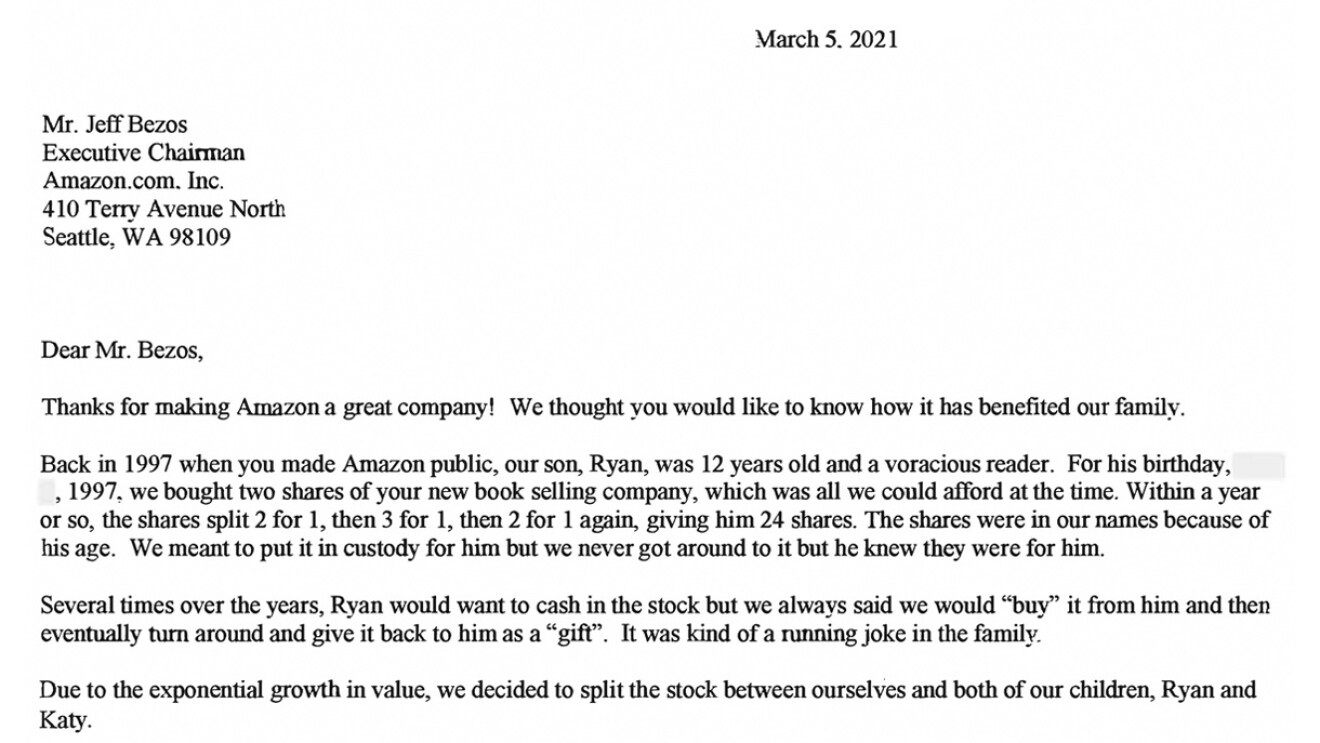
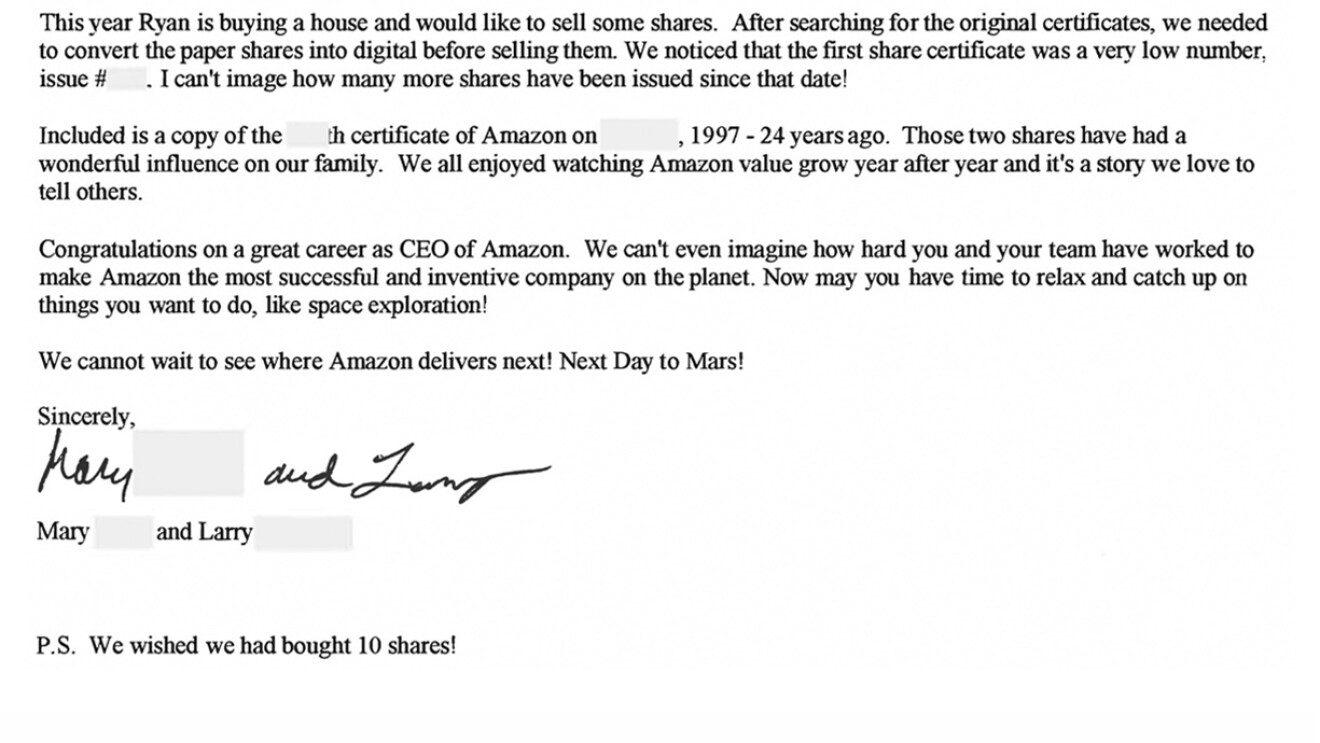
I am approached with similar stories all the time. I know people who’ve used their Amazon money for college, for emergencies, for houses, for vacations, to start their own business, for charity – and the list goes on. I’m proud of the wealth we’ve created for shareowners. It’s significant, and it improves their lives. But I also know something else: it’s not the largest part of the value we’ve created.
Create More Than You Consume
If you want to be successful in business (in life, actually), you have to create more than you consume. Your goal should be to create value for everyone you interact with. Any business that doesn’t create value for those it touches, even if it appears successful on the surface, isn’t long for this world. It’s on the way out.
Remember that stock prices are not about the past. They are a prediction of future cash flows discounted back to the present. The stock market anticipates. I’m going to switch gears for a moment and talk about the past. How much value did we create for shareowners in 2020? This is a relatively easy question to answer because accounting systems are set up to answer it. Our net income in 2020 was $21.3 billion. If, instead of being a publicly traded company with thousands of owners, Amazon were a sole proprietorship with a single owner, that’s how much the owner would have earned in 2020.
How about employees? This is also a reasonably easy value creation question to answer because we can look at compensation expense. What is an expense for a company is income for employees. In 2020, employees earned $80 billion, plus another $11 billion to include benefits and various payroll taxes, for a total of $91 billion.
How about third-party sellers? We have an internal team (the Selling Partner Services team) that works to answer that question. They estimate that, in 2020, third-party seller profits from selling on Amazon were between $25 billion and $39 billion, and to be conservative here I’ll go with $25 billion.
For customers, we have to break it down into consumer customers and AWS customers.
We’ll do consumers first. We offer low prices, vast selection, and fast delivery, but imagine we ignore all of that for the purpose of this estimate and value only one thing: we save customers time.
Customers complete 28% of purchases on Amazon in three minutes or less, and half of all purchases are finished in less than 15 minutes. Compare that to the typical shopping trip to a physical store – driving, parking, searching store aisles, waiting in the checkout line, finding your car, and driving home. Research suggests the typical physical store trip takes about an hour. If you assume that a typical Amazon purchase takes 15 minutes and that it saves you a couple of trips to a physical store a week, that’s more than 75 hours a year saved. That’s important. We’re all busy in the early 21st century.
So that we can get a dollar figure, let’s value the time savings at $10 per hour, which is conservative. Seventy-five hours multiplied by $10 an hour and subtracting the cost of Prime gives you value creation for each Prime member of about $630. We have 200 million Prime members, for a total in 2020 of $126 billion of value creation.
AWS is challenging to estimate because each customer’s workload is so different, but we’ll do it anyway, acknowledging up front that the error bars are high. Direct cost improvements from operating in the cloud versus on premises vary, but a reasonable estimate is 30%. Across AWS’s entire 2020 revenue of $45 billion, that 30% would imply customer value creation of $19 billion (what would have cost them $64 billion on their own cost $45 billion from AWS). The difficult part of this estimation exercise is that the direct cost reduction is the smallest portion of the customer benefit of moving to the cloud. The bigger benefit is the increased speed of software development – something that can significantly improve the customer’s competitiveness and top line. We have no reasonable way of estimating that portion of customer value except to say that it’s almost certainly larger than the direct cost savings. To be conservative here (and remembering we’re really only trying to get ballpark estimates), I’ll say it’s the same and call AWS customer value creation $38 billion in 2020.
Adding AWS and consumer together gives us total customer value creation in 2020 of $164 billion.
Summarizing:
Shareholders $21B
Employees $91B
3P Sellers $25B
Customers $164B
Total $301B
If each group had an income statement representing their interactions with Amazon, the numbers above would be the “bottom lines” from those income statements. These numbers are part of the reason why people work for us, why sellers sell through us, and why customers buy from us. We create value for them. And this value creation is not a zero-sum game. It is not just moving money from one pocket to another. Draw the box big around all of society, and you’ll find that invention is the root of all real value creation. And value created is best thought of as a metric for innovation.
Of course, our relationship with these constituencies and the value we create isn’t exclusively dollars and cents. Money doesn’t tell the whole story. Our relationship with shareholders, for example, is relatively simple. They invest and hold shares for a duration of their choosing. We provide direction to shareowners infrequently on matters such as annual meetings and the right process to vote their shares. And even then they can ignore those directions and just skip voting.
Our relationship with employees is a very different example. We have processes they follow and standards they meet. We require training and various certifications. Employees have to show up at appointed times. Our interactions with employees are many, and they’re fine-grained. It’s not just about the pay and the benefits. It’s about all the other detailed aspects of the relationship too.
Does your Chair take comfort in the outcome of the recent union vote in Bessemer? No, he doesn’t. I think we need to do a better job for our employees. While the voting results were lopsided and our direct relationship with employees is strong, it’s clear to me that we need a better vision for how we create value for employees – a vision for their success.
If you read some of the news reports, you might think we have no care for employees. In those reports, our employees are sometimes accused of being desperate souls and treated as robots. That’s not accurate. They’re sophisticated and thoughtful people who have options for where to work. When we survey fulfillment center employees, 94% say they would recommend Amazon to a friend as a place to work.
Employees are able to take informal breaks throughout their shifts to stretch, get water, use the rest room, or talk to a manager, all without impacting their performance. These informal work breaks are in addition to the 30-minute lunch and 30-minute break built into their normal schedule.
We don’t set unreasonable performance goals. We set achievable performance goals that take into account tenure and actual employee performance data. Performance is evaluated over a long period of time as we know that a variety of things can impact performance in any given week, day, or hour. If employees are on track to miss a performance target over a period of time, their manager talks with them and provides coaching.
Coaching is also extended to employees who are excelling and in line for increased responsibilities. In fact, 82% of coaching is positive, provided to employees who are meeting or exceeding expectations. We terminate the employment of less than 2.6% of employees due to their inability to perform their jobs (and that number was even lower in 2020 because of operational impacts of COVID-19).
Earth’s Best Employer and Earth’s Safest Place to Work
The fact is, the large team of thousands of people who lead operations at Amazon have always cared deeply for our hourly employees, and we’re proud of the work environment we’ve created. We’re also proud of the fact that Amazon is a company that does more than just create jobs for computer scientists and people with advanced degrees. We create jobs for people who never got that advantage.
Despite what we’ve accomplished, it’s clear to me that we need a better vision for our employees’ success. We have always wanted to be Earth’s Most Customer-Centric Company. We won’t change that. It’s what got us here. But I am committing us to an addition. We are going to be Earth’s Best Employer and Earth’s Safest Place to Work.
In my upcoming role as Executive Chair, I’m going to focus on new initiatives. I’m an inventor. It’s what I enjoy the most and what I do best. It’s where I create the most value. I’m excited to work alongside the large team of passionate people we have in Ops and help invent in this arena of Earth’s Best Employer and Earth’s Safest Place to Work. On the details, we at Amazon are always flexible, but on matters of vision we are stubborn and relentless. We have never failed when we set our minds to something, and we’re not going to fail at this either.
We dive deep into safety issues. For example, about 40% of work-related injuries at Amazon are related to musculoskeletal disorders (MSDs), things like sprains or strains that can be caused by repetitive motions. MSDs are common in the type of work that we do and are more likely to occur during an employee’s first six months. We need to invent solutions to reduce MSDs for new employees, many of whom might be working in a physical role for the first time.
One such program is WorkingWell – which we launched to 859,000 employees at 350 sites across North America and Europe in 2020 – where we coach small groups of employees on body mechanics, proactive wellness, and safety. In addition to reducing workplace injuries, these concepts have a positive impact on regular day-to-day activities outside work.
We’re developing new automated staffing schedules that use sophisticated algorithms to rotate employees among jobs that use different muscle-tendon groups to decrease repetitive motion and help protect employees from MSD risks. This new technology is central to a job rotation program that we’re rolling out throughout 2021.
Our increased attention to early MSD prevention is already achieving results. From 2019 to 2020, overall MSDs decreased by 32%, and MSDs resulting in time away from work decreased by more than half.
We employ 6,200 safety professionals at Amazon. They use the science of safety to solve complex problems and establish new industry best practices. In 2021, we’ll invest more than $300 million into safety projects, including an initial $66 million to create technology that will help prevent collisions of forklifts and other types of industrial vehicles.
When we lead, others follow. Two and a half years ago, when we set a $15 minimum wage for our hourly employees, we did so because we wanted to lead on wages – not just run with the pack – and because we believed it was the right thing to do. A recent paper by economists at the University of California-Berkeley and Brandeis University analyzed the impact of our decision to raise our minimum starting pay to $15 per hour. Their assessment reflects what we’ve heard from employees, their families, and the communities they live in.
Our increase in starting wage boosted local economies across the country by benefiting not only our own employees but also other workers in the same community. The study showed that our pay raise resulted in a 4.7% increase in the average hourly wage among other employers in the same labor market.
And we’re not done leading. If we want to be Earth’s Best Employer, we shouldn’t settle for 94% of employees saying they would recommend Amazon to a friend as a place to work. We have to aim for 100%. And we’ll do that by continuing to lead on wages, on benefits, on upskilling opportunities, and in other ways that we will figure out over time.
If any shareowners are concerned that Earth’s Best Employer and Earth’s Safest Place to Work might dilute our focus on Earth’s Most Customer-Centric Company, let me set your mind at ease. Think of it this way. If we can operate two businesses as different as consumer ecommerce and AWS, and do both at the highest level, we can certainly do the same with these two vision statements. In fact, I’m confident they will reinforce each other.
The Climate Pledge
In an earlier draft of this letter, I started this section with arguments and examples designed to demonstrate that human-induced climate change is real. But, bluntly, I think we can stop saying that now. You don’t have to say that photosynthesis is real, or make the case that gravity is real, or that water boils at 100 degrees Celsius at sea level. These things are simply true, as is the reality of climate change.
Not long ago, most people believed that it would be good to address climate change, but they also thought it would cost a lot and would threaten jobs, competitiveness, and economic growth. We now know better. Smart action on climate change will not only stop bad things from happening, it will also make our economy more efficient, help drive technological change, and reduce risks. Combined, these can lead to more and better jobs, healthier and happier children, more productive workers, and a more prosperous future. This doesn’t mean it will be easy. It won’t be. The coming decade will be decisive. The economy in 2030 will need to be vastly different from what it is today, and Amazon plans to be at the heart of the change. We launched The Climate Pledge together with Global Optimism in September 2019 because we wanted to help drive this positive revolution. We need to be part of a growing team of corporations that understand the imperatives and the opportunities of the 21st century.
Now, less than two years later, 53 companies representing almost every sector of the economy have signed The Climate Pledge. Signatories such as Best Buy, IBM, Infosys, Mercedes-Benz, Microsoft, Siemens, and Verizon have committed to achieve net-zero carbon in their worldwide businesses by 2040, 10 years ahead of the Paris Agreement. The Pledge also requires them to measure and report greenhouse gas emissions on a regular basis; implement decarbonization strategies through real business changes and innovations; and neutralize any remaining emissions with additional, quantifiable, real, permanent, and socially beneficial offsets. Credible, quality offsets are precious, and we should reserve them to compensate for economic activities where low-carbon alternatives don’t exist.
The Climate Pledge signatories are making meaningful, tangible, and ambitious commitments. Uber has a goal of operating as a zero-emission platform in Canada, Europe, and the U.S. by 2030, and Henkel plans to source 100% of the electricity it uses for production from renewable sources. Amazon is making progress toward our own goal of 100% renewable energy by 2025, five years ahead of our initial 2030 target. Amazon is the largest corporate buyer of renewable energy in the world. We have 62 utility-scale wind and solar projects and 125 solar rooftops on fulfillment and sort centers around the globe. These projects have the capacity to generate over 6.9 gigawatts and deliver more than 20 million megawatt-hours of energy annually.
Transportation is a major component of Amazon’s business operations and the toughest part of our plan to meet net-zero carbon by 2040. To help rapidly accelerate the market for electric vehicle technology, and to help all companies transition to greener technologies, we invested more than $1 billion in Rivian – and ordered 100,000 electric delivery vans from the company. We’ve also partnered with Mahindra in India and Mercedes-Benz in Europe. These custom electric delivery vehicles from Rivian are already operational, and they first hit the road in Los Angeles this past February. Ten thousand new vehicles will be on the road as early as next year, and all 100,000 vehicles will be on the road by 2030 – saving millions of metric tons of carbon. A big reason we want companies to join The Climate Pledge is to signal to the marketplace that businesses should start inventing and developing new technologies that signatories need to make good on the Pledge. Our purchase of 100,000 Rivian electric vans is a perfect example.
To further accelerate investment in new technologies needed to build a zero-carbon economy, we introduced the Climate Pledge Fund last June. The investment program started with $2 billion to invest in visionary companies that aim to facilitate the transition to a low-carbon economy. Amazon has already announced investments in CarbonCure Technologies, Pachama, Redwood Materials, Rivian, Turntide Technologies, ZeroAvia, and Infinium – and these are just some of the innovative companies we hope will build the zero-carbon economy of the future.
I have also personally allocated $10 billion to provide grants to help catalyze the systemic change we will need in the coming decade. We’ll be supporting leading scientists, activists, NGOs, environmental justice organizations, and others working to fight climate change and protect the natural world. Late last year, I made my first round of grants to 16 organizations working on innovative and needle-moving solutions. It’s going to take collective action from big companies, small companies, nation states, global organizations, and individuals, and I’m excited to be part of this journey and optimistic that humanity can come together to solve this challenge.
Differentiation is Survival and the Universe Wants You to be Typical
This is my last annual shareholder letter as the CEO of Amazon, and I have one last thing of utmost importance I feel compelled to teach. I hope all Amazonians take it to heart.
Here is a passage from Richard Dawkins’ (extraordinary) book The Blind Watchmaker. It’s about a basic fact of biology.
“Staving off death is a thing that you have to work at. Left to itself – and that is what it is when it dies – the body tends to revert to a state of equilibrium with its environment. If you measure some quantity such as the temperature, the acidity, the water content or the electrical potential in a living body, you will typically find that it is markedly different from the corresponding measure in the surroundings. Our bodies, for instance, are usually hotter than our surroundings, and in cold climates they have to work hard to maintain the differential. When we die the work stops, the temperature differential starts to disappear, and we end up the same temperature as our surroundings. Not all animals work so hard to avoid coming into equilibrium with their surrounding temperature, but all animals do some comparable work. For instance, in a dry country, animals and plants work to maintain the fluid content of their cells, work against a natural tendency for water to flow from them into the dry outside world. If they fail they die. More generally, if living things didn’t work actively to prevent it, they would eventually merge into their surroundings, and cease to exist as autonomous beings. That is what happens when they die.”
While the passage is not intended as a metaphor, it’s nevertheless a fantastic one, and very relevant to Amazon. I would argue that it’s relevant to all companies and all institutions and to each of our individual lives too. In what ways does the world pull at you in an attempt to make you normal? How much work does it take to maintain your distinctiveness? To keep alive the thing or things that make you special?
I know a happily married couple who have a running joke in their relationship. Not infrequently, the husband looks at the wife with faux distress and says to her, “Can’t you just be normal?” They both smile and laugh, and of course the deep truth is that her distinctiveness is something he loves about her. But, at the same time, it’s also true that things would often be easier – take less energy – if we were a little more normal.
This phenomenon happens at all scale levels. Democracies are not normal. Tyranny is the historical norm. If we stopped doing all of the continuous hard work that is needed to maintain our distinctiveness in that regard, we would quickly come into equilibrium with tyranny.
We all know that distinctiveness – originality – is valuable. We are all taught to “be yourself.” What I’m really asking you to do is to embrace and be realistic about how much energy it takes to maintain that distinctiveness. The world wants you to be typical – in a thousand ways, it pulls at you. Don’t let it happen.
You have to pay a price for your distinctiveness, and it’s worth it. The fairy tale version of “be yourself” is that all the pain stops as soon as you allow your distinctiveness to shine. That version is misleading. Being yourself is worth it, but don’t expect it to be easy or free. You’ll have to put energy into it continuously.
The world will always try to make Amazon more typical – to bring us into equilibrium with our environment. It will take continuous effort, but we can and must be better than that.
* * *
As always, I attach our 1997 shareholder letter. It concluded with this: “We at Amazon.com are grateful to our customers for their business and trust, to each other for our hard work, and to our shareholders for their support and encouragement.” That hasn’t changed a bit. I want to especially thank Andy Jassy for agreeing to take on the CEO role. It’s a hard job with a lot of responsibility. Andy is brilliant and has the highest of high standards. I guarantee you that Andy won’t let the universe make us typical. He will muster the energy needed to keep alive in us what makes us special. That won’t be easy, but it is critical. I also predict it will be satisfying and oftentimes fun. Thank you, Andy.
To all of you: be kind, be original, create more than you consume, and never, never, never let the universe smooth you into your surroundings. It remains Day 1.
Sincerely,
Jeffrey P. Bezos
Founder and Chief Executive Officer
Amazon.com, Inc.
To our shareholders:
Amazon.com passed many milestones in 1997: by year-end, we had served more than 1.5 million customers, yielding 838% revenue growth to $147.8 million, and extended our market leadership despite aggressive competitive entry.
But this is Day 1 for the Internet and, if we execute well, for Amazon.com. Today, online commerce saves customers money and precious time. Tomorrow, through personalization, online commerce will accelerate the very process of discovery. Amazon.com uses the Internet to create real value for its customers and, by doing so, hopes to create an enduring franchise, even in established and large markets.
We have a window of opportunity as larger players marshal the resources to pursue the online opportunity and as customers, new to purchasing online, are receptive to forming new relationships. The competitive landscape has continued to evolve at a fast pace. Many large players have moved online with credible offerings and have devoted substantial energy and resources to building awareness, traffic, and sales. Our goal is to move quickly to solidify and extend our current position while we begin to pursue the online commerce opportunities in other areas. We see substantial opportunity in the large markets we are targeting. This strategy is not without risk: it requires serious investment and crisp execution against established franchise leaders.
It’s All About the Long Term
We believe that a fundamental measure of our success will be the shareholder value we create over the long term. This value will be a direct result of our ability to extend and solidify our current market leadership position. The stronger our market leadership, the more powerful our economic model. Market leadership can translate directly to higher revenue, higher profitability, greater capital velocity, and correspondingly stronger returns on invested capital.
Our decisions have consistently reflected this focus. We first measure ourselves in terms of the metrics most indicative of our market leadership: customer and revenue growth, the degree to which our customers continue to purchase from us on a repeat basis, and the strength of our brand. We have invested and will continue to invest aggressively to expand and leverage our customer base, brand, and infrastructure as we move to establish an enduring franchise.
Because of our emphasis on the long term, we may make decisions and weigh tradeoffs differently than some companies. Accordingly, we want to share with you our fundamental management and decision-making approach so that you, our shareholders, may confirm that it is consistent with your investment philosophy:
- We will continue to focus relentlessly on our customers.
- We will continue to make investment decisions in light of long-term market leadership considerations rather than short-term profitability considerations or short-term Wall Street reactions.
- We will continue to measure our programs and the effectiveness of our investments analytically, to jettison those that do not provide acceptable returns, and to step up our investment in those that work best. We will continue to learn from both our successes and our failures.
- We will make bold rather than timid investment decisions where we see a sufficient probability of gaining market leadership advantages. Some of these investments will pay off, others will not, and we will have learned another valuable lesson in either case.
- When forced to choose between optimizing the appearance of our GAAP accounting and maximizing the present value of future cash flows, we’ll take the cash flows.
- We will share our strategic thought processes with you when we make bold choices (to the extent competitive pressures allow), so that you may evaluate for yourselves whether we are making rational long-term leadership investments.
- We will work hard to spend wisely and maintain our lean culture. We understand the importance of continually reinforcing a cost-conscious culture, particularly in a business incurring net losses.
- We will balance our focus on growth with emphasis on long-term profitability and capital management. At this stage, we choose to prioritize growth because we believe that scale is central to achieving the potential of our business model.
- We will continue to focus on hiring and retaining versatile and talented employees, and continue to weight their compensation to stock options rather than cash. We know our success will be largely affected by our ability to attract and retain a motivated employee base, each of whom must think like, and therefore must actually be, an owner.
We aren’t so bold as to claim that the above is the “right” investment philosophy, but it’s ours, and we would be remiss if we weren’t clear in the approach we have taken and will continue to take.
With this foundation, we would like to turn to a review of our business focus, our progress in 1997, and our outlook for the future.
Obsess Over Customers
From the beginning, our focus has been on offering our customers compelling value. We realized that the Web was, and still is, the World Wide Wait. Therefore, we set out to offer customers something they simply could not get any other way, and began serving them with books. We brought them much more selection than was possible in a physical store (our store would now occupy 6 football fields), and presented it in a useful, easy- to-search, and easy-to-browse format in a store open 365 days a year, 24 hours a day. We maintained a dogged focus on improving the shopping experience, and in 1997 substantially enhanced our store. We now offer customers gift certificates, 1-Click shopping℠, and vastly more reviews, content, browsing options, and recommendation features. We dramatically lowered prices, further increasing customer value. Word of mouth remains the most powerful customer acquisition tool we have, and we are grateful for the trust our customers have placed in us. Repeat purchases and word of mouth have combined to make Amazon.com the market leader in online bookselling.
By many measures, Amazon.com came a long way in 1997:
- Sales grew from $15.7 million in 1996 to $147.8 million – an 838% increase.
- Cumulative customer accounts grew from 180,000 to 1,510,000 – a 738% increase.
- The percentage of orders from repeat customers grew from over 46% in the fourth quarter of 1996 to over 58% in the same period in 1997.
- In terms of audience reach, per Media Metrix, our Web site went from a rank of 90th to within the top 20.
- We established long-term relationships with many important strategic partners, including America Online, Yahoo!, Excite, Netscape, GeoCities, AltaVista, @Home, and Prodigy.
Infrastructure
During 1997, we worked hard to expand our business infrastructure to support these greatly increased traffic, sales, and service levels:
- Amazon.com’s employee base grew from 158 to 614, and we significantly strengthened our management team.
- Distribution center capacity grew from 50,000 to 285,000 square feet, including a 70% expansion of our Seattle facilities and the launch of our second distribution center in Delaware in November.
- Inventories rose to over 200,000 titles at year-end, enabling us to improve availability for our customers.
- Our cash and investment balances at year-end were $125 million, thanks to our initial public offering in May 1997 and our $75 million loan, affording us substantial strategic flexibility.
Our Employees
The past year’s success is the product of a talented, smart, hard-working group, and I take great pride in being a part of this team. Setting the bar high in our approach to hiring has been, and will continue to be, the single most important element of Amazon.com’s success.
It’s not easy to work here (when I interview people I tell them, “You can work long, hard, or smart, but at Amazon.com you can’t choose two out of three”), but we are working to build something important, something that matters to our customers, something that we can all tell our grandchildren about. Such things aren’t meant to be easy. We are incredibly fortunate to have this group of dedicated employees whose sacrifices and passion build Amazon.com.
Goals for 1998
We are still in the early stages of learning how to bring new value to our customers through Internet commerce and merchandising. Our goal remains to continue to solidify and extend our brand and customer base. This requires sustained investment in systems and infrastructure to support outstanding customer convenience, selection, and service while we grow. We are planning to add music to our product offering, and over time we believe that other products may be prudent investments. We also believe there are significant opportunities to better serve our customers overseas, such as reducing delivery times and better tailoring the customer experience. To be certain, a big part of the challenge for us will lie not in finding new ways to expand our business, but in prioritizing our investments.
We now know vastly more about online commerce than when Amazon.com was founded, but we still have so much to learn. Though we are optimistic, we must remain vigilant and maintain a sense of urgency. The challenges and hurdles we will face to make our long-term vision for Amazon.com a reality are several: aggressive, capable, well-funded competition; considerable growth challenges and execution risk; the risks of product and geographic expansion; and the need for large continuing investments to meet an expanding market opportunity. However, as we’ve long said, online bookselling, and online commerce in general, should prove to be a very large market, and it’s likely that a number of companies will see significant benefit. We feel good about what we’ve done, and even more excited about what we want to do.
1997 was indeed an incredible year. We at Amazon.com are grateful to our customers for their business and trust, to each other for our hard work, and to our shareholders for their support and encouragement.
Jeffrey P. Bezos
Founder and Chief Executive Officer
Amazon.com, Inc.
2021 Letter to Shareholders
Dear shareholders:
Over the past 25 years at Amazon, I’ve had the opportunity to write many narratives, emails, letters, and keynotes for employees, customers, and partners. But, this is the first time I’ve had the honor of writing our annual shareholder letter as CEO of Amazon. Jeff set the bar high on these letters, and I will try to keep them worth reading.
When the pandemic started in early 2020, few people thought it would be as expansive or long-running as it’s been. Whatever role Amazon played in the world up to that point became further magnified as most physical venues shut down for long periods of time and people spent their days at home. This meant that hundreds of millions of people relied on Amazon for PPE, food, clothing, and various other items that helped them navigate this unprecedented time. Businesses and governments also had to shift, practically overnight, from working with colleagues and technology on-premises to working remotely. AWS played a major role in enabling this business continuity. Whether companies saw extraordinary demand spikes, or demand diminish quickly with reduced external consumption, the cloud’s elasticity to scale capacity up and down quickly, as well as AWS’s unusually broad functionality helped millions of companies adjust to these difficult circumstances.
Our AWS and Consumer businesses have had different demand trajectories during the pandemic. In the first year of the pandemic, AWS revenue continued to grow at a rapid clip—30% year over year (“YoY”) in 2020 on a $35 billion annual revenue base in 2019—but slower than the 37% YoY growth in 2019. This was due in part to the uncertainty and slowing demand that so many businesses encountered, but also in part to our helping companies optimize their AWS footprint to save money. Concurrently, companies were stepping back and determining what they wanted to change coming out of the pandemic. Many concluded that they didn’t want to continue managing their technology infrastructure themselves, and made the decision to accelerate their move to the cloud. This shift by so many companies (along with the economy recovering) helped re-accelerate AWS’s revenue growth to 37% YoY in 2021.
Conversely, our Consumer revenue grew dramatically in 2020. In 2020, Amazon’s North America and International Consumer revenue grew 39% YoY on the very large 2019 revenue base of $245 billion; and, this extraordinary growth extended into 2021 with revenue increasing 43% YoY in Q1 2021. These are astounding numbers. We realized the equivalent of three years’ forecasted growth in about 15 months.
As the world opened up again starting in late Q2 2021, and more people ventured out to eat, shop, and travel, consumer spending returned to being spread over many more entities. We weren’t sure what to expect in 2021, but the fact that we continued to grow at double digit rates (with a two-year Consumer compounded annual growth rate of 29%) was encouraging as customers appreciated the role Amazon played for them during the pandemic, and started using Amazon for a larger amount of their household purchases.
This growth also created short-term logistics and cost challenges. We spent Amazon’s first 25 years building a very large fulfillment network, and then had to double it in the last 24 months to meet customer demand. As we were bringing this new capacity online, the labor market tightened considerably, making it challenging both to receive all of the inventory our vendors and sellers wanted to send us and to place that inventory as close to customers as we typically do. Combined with ocean, air, and trucking capacity becoming scarcer and more expensive, this created extra transportation and productivity costs. Supply chains were disrupted in ways none of us had seen previously. We hoped that the major impact from COVID-19 would recede as 2021 drew to a close, but then omicron reared its head in December, which had worldwide ramifications, including impacting people’s ability to work. And then in late February, with Russia’s invasion of Ukraine, fuel costs and inflation became bigger issues with which to contend.
So, 2021 was a crazy and unpredictable year, continuing a trend from 2020. But, I’m proud of the incredible commitment and effort from our employees all over the world. I’m not sure any of us would have gotten through the pandemic the same way without the dedication and extraordinary efforts shown by our teams during this period, and I’m eternally grateful.
It’s not normal for a company of any size to be able to respond to something as discontinuous and unpredictable as this pandemic turned out to be. What is it about Amazon that made it possible for us to do so? It’s because we weren’t starting from a standing start. We had been iterating on and remaking our fulfillment capabilities for nearly two decades. In every business we pursue, we’re constantly experimenting and inventing. We’re divinely discontented with customer experiences, whether they’re our own or not. We believe these customer experiences can always be better, and we strive to make customers’ lives better and easier every day. The beauty of this mission is that you never run out of runway; customers always want better, and our job is both to listen to their feedback and to imagine what else is possible and invent on their behalf.
People often assume that the game-changing inventions they admire just pop out of somebody’s head, a light bulb goes off, a team executes to that idea, and presto—you have a new invention that’s a breakaway success for a long time. That’s rarely, if ever, how it happens. One of the lesser known facts about innovative companies like Amazon is that they are relentlessly debating, re-defining, tinkering, iterating, and experimenting to take the seed of a big idea and make it into something that resonates with customers and meaningfully changes their customer experience over a long period of time.
Let me give you some Amazon examples.
Our Fulfillment Network: Going back to the pandemic, there’s no way we could have started working on our fulfillment network in March 2020 and satisfied anything close to what our customers needed. We’d been innovating in our fulfillment network for 20 years, constantly trying to shorten the time to get items to customers. In the early 2000s, it took us an average of 18 hours to get an item through our fulfillment centers and on the right truck for shipment. Now, it takes us two. To deliver as reliably and cost-effectively as we desire, and to serve Amazon Prime members expecting shipments in a couple of days, we spent years building out an expansive set of fulfillment centers, a substantial logistics and transportation capability, and reconfigured how we did virtually everything in our facilities. For perspective, in 2004, we had seven fulfillment centers in the U.S. and four in other parts of the world, and we hadn’t yet added delivery stations, which connect our fulfillment and sortation centers to the last-mile delivery vans you see driving around your neighborhood. Fast forward to the end of 2021, we had 253 fulfillment centers, 110 sortation centers, and 467 delivery stations in North America, with an additional 157 fulfillment centers, 58 sortation centers, and 588 delivery stations across the globe. Our delivery network grew to more than 260,000 drivers worldwide, and our Amazon Air cargo fleet has more than 100 aircraft. This has represented a capital investment of over $100 billion and countless iterations and small process improvements by over a million Amazonians in the last decade and a half.
Ironically, just before COVID started, we’d made the decision to invest billions of incremental dollars over several years to deliver an increasing number of Prime shipments in one day. This initiative was slowed by the challenges of the pandemic, but we’ve since resumed our focus here. Delivering a substantial amount of shipments in one day is hard (especially across the millions of items that we offer) and initially expensive as we build out the infrastructure to scale this efficiently. But, we believe our over 200 million Prime customers, who will tell you very clearly that faster is almost always better, will love this. So, this capability to ship millions of items within a couple days (and increasingly one day) was not from one aha moment and not developed in a year or two. It’s been hard-earned by putting ourselves in the shoes of our customers, knowing what they wanted, organizing Amazonians to work together to invent better solutions, and investing a large amount of financial and people resources over 20 years (often well in advance of when it would payout). This type of iterative innovation is never finished and has periodic peaks in investment years, but leads to better long-term customer experiences, customer loyalty, and returns for our shareholders.
AWS: As we were defining AWS and working backwards on the services we thought customers wanted, we kept triggering one of the biggest tensions in product development—where to draw the line on functionality in V1. One early meeting in particular—for our core compute service called Elastic Compute Cloud ("EC2")—was scheduled for an hour, and took three, as we animatedly debated whether we could launch a compute service without an accompanying persistent block storage companion (a form of network attached storage). Everybody agreed that having a persistent block store was important to a complete compute service; however, to have one ready would take an extra year. The question became could we offer customers a useful service where they could get meaningful value before we had all the features we thought they wanted? We decided that the initial launch of EC2 could be feature-poor if we also organized ourselves to listen to customers and iterate quickly. This approach works well if you indeed iterate quickly; but, is disastrous if you can’t. We launched EC2 in 2006 with one instance size, in one data center, in one region of the world, with Linux operating system instances only (no Windows), without monitoring, load balancing, auto-scaling, or yes, persistent storage. EC2 was an initial success, but nowhere near the multi-billion-dollar service it’s become until we added the missing capabilities listed above, and then some.
In the early days of AWS, people sometimes asked us why compute wouldn’t just be an undifferentiated commodity. But, there’s a lot more to compute than just a server. Customers want various flavors of compute (e.g. server configurations optimized for storage, memory, high-performance compute, graphics rendering, machine learning), multiple form factors (e.g. fixed instance sizes, portable containers, serverless functions), various sizes and optimizations of persistent storage, and a slew of networking capabilities. Then, there’s the CPU chip that runs in your compute. For many years, the industry had used Intel or AMDx86 processors. We have important partnerships with these companies, but realized that if we wanted to push price and performance further (as customers requested), we’d have to develop our own chips, too. Our first generalized chip was Graviton, which we announced in 2018. This helped a subset of customer workloads run more cost-effectively than prior options. But, it wasn’t until 2020, after taking the learnings from Graviton and innovating on a new chip, that we had something remarkable with our Graviton2 chip, which provides up to 40% better price-performance than the comparable latest generation x86 processors. Think about how much of an impact 40% improvement on compute is. Compute is used for every bit of technology. That’s a huge deal for customers. And, while Graviton2 has been a significant success thus far (48 of the top 50 AWS EC2 customers have already adopted it), the AWS Chips team was already learning from what customers said could be better, and announced Graviton3 this past December (offering a 25% improvement on top of Graviton2’s relative gains). The list of what we’ve invented and delivered for customers in EC2 (and AWS in general) is pretty mind-boggling, and this iterative approach to innovation has not only given customers much more functionality in AWS than they can find anywhere else (which is a significant differentiator), but also allowed us to arrive at the much more game-changing offering that AWS is today.
Devices: Our first foray into devices was the Kindle, released in 2007. It was not the most sophisticated industrial design (it was creamy white in color and the corners were uncomfortable for some people to hold), but revolutionary because it offered customers the ability to download any of over 90,000 books (now millions) in 60 seconds—and we got better and faster at building attractive designs. Shortly thereafter, we launched a tablet, and then a phone (with the distinguishing feature of having front-facing cameras and a gyroscope to give customers a dynamic perspective along with varied 3D experiences). The phone was unsuccessful, and though we determined we were probably too late to this party and directed these resources elsewhere, we hired some fantastic long-term builders and learned valuable lessons from this failure that have served us well in devices like Echo and FireTV.
When I think of the first Echo device—and what Alexa could do for customers at that point—it was noteworthy, yet so much less capable than what’s possible today. Today, there are hundreds of millions of Alexa-enabled devices out there (in homes, offices, cars, hotel rooms, Amazon Echo devices, and third-party manufacturer devices); you can listen to music—or watch videos now; you can control your lights and home automation; you can create routines like “Start My Day” where Alexa tells you the weather, your estimated commute time based on current traffic, then plays the news; you can easily order retail items on Amazon; you can get general or customized news, updates on sporting events and related stats—and we’re still quite early with respect to what Alexa and Alexa-related devices will do for customers. Our goal is for Alexa to be the world’s most helpful and resourceful personal assistant, who makes people’s lives meaningfully easier and better. We have a lot more inventing and iterating to go, but customers continue to indicate that we’re on the right path. We have several other devices at varying stages of evolution (e.g. Ring and Blink provide the leading digital home security solutions, Astro is a brand new home robot that we just launched in late 2021), but it’s safe to say that every one of our devices, whether you’re talking about Kindle, FireTV, Alexa/Echo, Ring, Blink, or Astro is an invention-in-process with a lot more coming that will keep improving customers’ lives.
Prime Video: We started in 2006 with an offering called Amazon Unbox where customers could download about a thousand movies from major studios. This made sense as bandwidth was slower those days (it would take an hour to download a video). But, as bandwidth got much faster to people’s homes and mobile devices, along with the advent of connected TVs, streaming was going to be a much better customer solution, and we focused our efforts on streaming. In 2011, we started offering over 5,000 streaming movies and shows as part of customers’ Amazon Prime subscriptions. Initially, all of our content was produced by other studios and entertainment companies. These deals were expensive, country-specific, and only available to us for a limited period; so, to expand our options, we started creating our own original shows. Our early efforts included short-lived shows like Alpha House and Betas, before we had our first award-winning series in Transparent, and eventually created multi-year franchises in The Marvelous Mrs. Maisel, The Boys, Bosch, and Jack Ryan. Along the way, we’ve learned a lot about producing compelling entertainment with memorable moments and using machine learning and other inventive technology to provide a superior-quality streaming experience (with useful, relevant data about actors, TV shows, movies, music, or sports stats a click away in our unique X-Ray feature). You might have seen some of this in action in our recent new hit series, Reacher, and you’ll hopefully see it in our upcoming Lord of the Rings series launch (coming Labor Day 2022). We also expect that you’ll see this iterative invention when we launch Thursday Night Football, the NFL’s first weekly, prime time, streaming-only broadcast, airing exclusively on Prime Video starting in September 2022. Our agreement with the NFL is for 11 years, and we will work relentlessly over the next several years to reinvent the NFL viewing experience for football fans.
This track record of frequent invention is not only why more sports entities are choosing to work with Prime Video, but also why so many large entertainment companies have become Prime Video Channels partners. Channels is a program that enables entertainment companies to leverage Prime Video’s unique technology and viewing experience, as well as its very large member base to offer monthly subscriptions to their content. Companies like Warner Bros. Discovery, Paramount, Starz, Corus Entertainment, and Globo have found that they’re driving substantial incremental membership and better customer experience through Channels. While there is so much progress in Prime Video from where we started, we have more invention in front of us in the next 15 years than the last 15—and our team is passionately committed to providing customers with the most expansive collection of compelling content anywhere in the world.
This same sort of iterative invention can be applied to efforts supporting people and communities. Last summer, we added two new Leadership Principles: Strive to be Earth’s Best Employer and Success and Scale Bring Broad Responsibility. These concepts were always implicit at Amazon, but explicit Leadership Principles help us ask ourselves—and empower more Amazonians at all levels to ask—whether we’re living up to these principles.
For example, more than a million Amazonians work in our fulfillment network. In 2018, we championed the $15 minimum wage (which is more than double the federal minimum wage), but haven’t stopped there. We continued to increase compensation such that our average starting hourly salary is currently over $18. Along with this compensation, we offer very robust benefits, including full health insurance, a 401K plan, up to 20 weeks of parental leave, and full tuition coverage for associates who want to get a college education (whether they remain with us or not). We’re not close to being done in how we improve the lives of our employees. We’ve researched and created a list of what we believe are the top 100 employee experience pain points and are systematically solving them. We’re also passionate about further improving safety in our fulfillment network, with a focus on reducing strains, sprains, falls, and repetitive stress injuries. Our injury rates are sometimes misunderstood. We have operations jobs that fit both the "warehousing” and "courier and delivery” categories. In the last U.S. public numbers, our recordable incident rates were a little higher than the average of our warehousing peers (6.4 vs. 5.5), and a little lower than the average of our courier and delivery peers (7.6 vs. 9.1). This makes us about average relative to peers, but we don’t seek to be average. We want to be best in class. When I first started in my new role, I spent significant time in our fulfillment centers and with our safety team, and hoped there might be a silver bullet that could change the numbers quickly. I didn’t find that. At our scale (we hired over 300,000 people in 2021 alone, many of whom were new to this sort of work and needed training), it takes rigorous analysis, thoughtful problem-solving, and a willingness to invent to get to where you want. We’ve been dissecting every process path to discern how we can further improve. We have a variety of programs in flight (e.g. rotational programs that help employees avoid spending too much time doing the same repetitive motions, wearables that prompt employees when they’re moving in a dangerous way, improved shoes to provide better toe protection, training programs on body mechanics, wellness, and safety practices). But, we still have a ways to go, and we’ll approach it like we do other customer experiences—we’ll keep learning, inventing, and iterating until we have more transformational results. We won’t be satisfied until we do.
Similarly, at our scale, we have a significant carbon footprint. It’s a big part of why we created The Climate Pledge a few years ago (a pledge to be net-zero carbon by 2040, ten years ahead of the Paris Agreement). We’re making significant progress on this effort (we’re committed to powering our operations with 100% renewable energy by 2025—five years ahead of our original target of 2030, we have ordered over 100,000 electric vans to deliver packages, and have over 300 companies who’ve joined us in The Climate Pledge). But, we have a different challenge than most companies given the diversity and intensity of our operations (including shipping billions of packages per year). We’re committed to the challenge, but it will take relentless invention.
We also are trying to increase the amount of affordable housing in the communities in which we have a large presence. Our more than $2 billion Housing Equity Fund that we started a year ago has already allocated $1.2 billion toward affordable housing initiatives in the areas around Washington state’s Puget Sound region, Arlington (Virginia), and Nashville (Tennessee).
A final quick example is Kuiper, our low Earth orbit satellite network that we’re spending over $10 billion to build in the next several years. Kuiper will serve customers with minimal to no fixed broadband connectivity, changing access to information and resources for many communities (analysts estimate approximately 300-400 million customers globally are in this category). We’re optimistic that there is a pretty good business model for us too, but we’ll see—and it’s a real game changer for underserved families and businesses that will unfold over many years as we keep evolving its capabilities.
This type of iterative innovation is pervasive across every team at Amazon. I could have given comparable examples in Advertising, Grocery, Gaming, Amazon Music, Amazon Care (our telemedicine offering), or Pharmacy, to name a few. All of these stories are still being written as we rapidly experiment, learn, and continue to try to make our customer experience better every day.
If this approach sounds appealing, a natural question is what’s required to get good at it? It’s easier said than done, but here are some components that have helped us:
1/ Hire the Right Builders: We disproportionately index in hiring builders. We think of builders as people who like to invent, who look at customer experiences, dissect what doesn’t work well about them, and seek to reinvent them. We want people who keep asking why can’t it be done? We want people who like to experiment and tinker, and who realize launch is the starting line, not the finish line.
2/ Organize Builders into Teams That Are as Separable and Autonomous as Possible: It’s hard for teams to be deep in what customers care about in multiple areas. It’s also hard to spend enough time on the new initiatives when there’s resource contention with the more mature businesses; the surer bets usually win out. Single-threaded teams will know their customers’ needs better, spend all their waking work hours inventing for them, and develop context and tempo to keep iterating quickly.
3/ Give Teams the Right Tools and Permission to Move Fast: Speed is not pre-ordained. It’s a leadership choice. It has trade-offs, but you can’t wake up one day and start moving fast. It requires having the right tools to experiment and build fast (a major part of why we started AWS), allowing teams to make two-way door decisions themselves, and setting an expectation that speed matters. And, it does. Speed is disproportionally important to every business at every stage of its evolution. Those that move slower than their competitive peers fall away over time.
4/ You Need Blind Faith, But No False Hope: This is a lyric from one of my favorite Foo Fighters songs (“Congregation”). When you invent, you come up with new ideas that people will reject because they haven’t been done before (that’s where the blind faith comes in), but it’s also important to step back and make sure you have a viable plan that’ll resonate with customers (avoid false hope). We’re lucky that we have builders who challenge each other, feedback loops that give us access to customer feedback, and a product development process of working backwards from the customer where having to write a Press Release (to flesh out the customer benefits) and a Frequently Asked Questions document (to detail how we’d build it) helps us have blind faith without false hope (at least usually).
5/ Define a Minimum Loveable Product (MLP), and Be Willing to Iterate Fast: Figuring out where to draw the line for launch is one of the most difficult decisions teams must make. Often, teams wait too long, and insist on too many bells and whistles, before launching. And, they miss the first mover advantage or opportunity to build mindshare in fast-moving market segments before well-executing peers get too far ahead. The launch product must be good enough that you believe it’ll be loved from the get-go (why we call it a "Minimum Loveable Product" vs. a "Minimum Viable Product"), but in newer market segments, teams are often better off getting this MLP to customers and iterating quickly thereafter.
6/ Adopt a Long-term Orientation: We’re sometimes criticized at Amazon for not shutting much down. It’s true that we have a longer tolerance for our investments than most companies. But, we know that transformational invention takes multiple years, and if you’re making big bets that you believe could substantially change customer experience (and your company), you have to be in it for the long-haul or you’ll give up too quickly.
7/ Brace Yourself for Failure: If you invent a lot, you will fail more often than you wish. Nobody likes this part, but it comes with the territory. When it’s clear that we’ve launched something that won’t work, we make sure we’ve learned from what didn’t go well, and secure great landing places for team members who delivered well—or your best people will hesitate to work on new initiatives.
Albert Einstein is sometimes credited with describing compound interest as the eighth wonder of the world ("He who understands it, earns it. He who doesn’t, pays it"). We think of iterative innovation in much the same way. Iterative innovation creates magic for customers. Constantly inventing and improving products for customers has a compounding effect on the customer experience, and in turn on a business’s prospects.
Time is your friend when you are compounding gains. Amazon is a big company with some large businesses, but it’s still early days for us. We will continue to be insurgent—inventing in businesses that we’re in, in new businesses that we’ve yet to launch, and in new ideas that we haven’t even imagined yet. It remains Day 1.
Sincerely,
Andy Jassy
President and Chief Executive Officer
Amazon.com, Inc.
P.S. As we have always done, our original 1997 Shareholder Letter follows. What’s written there is as true today as it was in 1997.
To our shareholders:
Amazon.com passed many milestones in 1997: by year-end, we had served more than 1.5 million customers, yielding 838% revenue growth to $147.8 million, and extended our market leadership despite aggressive competitive entry.
But this is Day 1 for the Internet and, if we execute well, for Amazon.com. Today, online commerce saves customers money and precious time. Tomorrow, through personalization, online commerce will accelerate the very process of discovery. Amazon.com uses the Internet to create real value for its customers and, by doing so, hopes to create an enduring franchise, even in established and large markets.
We have a window of opportunity as larger players marshal the resources to pursue the online opportunity and as customers, new to purchasing online, are receptive to forming new relationships. The competitive landscape has continued to evolve at a fast pace. Many large players have moved online with credible offerings and have devoted substantial energy and resources to building awareness, traffic, and sales. Our goal is to move quickly to solidify and extend our current position while we begin to pursue the online commerce opportunities in other areas. We see substantial opportunity in the large markets we are targeting. This strategy is not without risk: it requires serious investment and crisp execution against established franchise leaders.
It’s All About the Long Term
We believe that a fundamental measure of our success will be the shareholder value we create over the long term. This value will be a direct result of our ability to extend and solidify our current market leadership position. The stronger our market leadership, the more powerful our economic model. Market leadership can translate directly to higher revenue, higher profitability, greater capital velocity, and correspondingly stronger returns on invested capital.
Our decisions have consistently reflected this focus. We first measure ourselves in terms of the metrics most indicative of our market leadership: customer and revenue growth, the degree to which our customers continue to purchase from us on a repeat basis, and the strength of our brand. We have invested and will continue to invest aggressively to expand and leverage our customer base, brand, and infrastructure as we move to establish an enduring franchise.
Because of our emphasis on the long term, we may make decisions and weigh tradeoffs differently than some companies. Accordingly, we want to share with you our fundamental management and decision-making approach so that you, our shareholders, may confirm that it is consistent with your investment philosophy:
- We will continue to focus relentlessly on our customers.
- We will continue to make investment decisions in light of long-term market leadership considerations rather than short-term profitability considerations or short-term Wall Street reactions.
- We will continue to measure our programs and the effectiveness of our investments analytically, to jettison those that do not provide acceptable returns, and to step up our investment in those that work best. We will continue to learn from both our successes and our failures.
- We will make bold rather than timid investment decisions where we see a sufficient probability of gaining market leadership advantages. Some of these investments will pay off, others will not, and we will have learned another valuable lesson in either case.
- When forced to choose between optimizing the appearance of our GAAP accounting and maximizing the present value of future cash flows, we’ll take the cash flows.
- We will share our strategic thought processes with you when we make bold choices (to the extent competitive pressures allow), so that you may evaluate for yourselves whether we are making rational long-term leadership investments.
- We will work hard to spend wisely and maintain our lean culture. We understand the importance of continually reinforcing a cost-conscious culture, particularly in a business incurring net losses.
- We will balance our focus on growth with emphasis on long-term profitability and capital management. At this stage, we choose to prioritize growth because we believe that scale is central to achieving the potential of our business model.
- We will continue to focus on hiring and retaining versatile and talented employees, and continue to weight their compensation to stock options rather than cash. We know our success will be largely affected by our ability to attract and retain a motivated employee base, each of whom must think like, and therefore must actually be, an owner.
We aren’t so bold as to claim that the above is the “right” investment philosophy, but it’s ours, and we would be remiss if we weren’t clear in the approach we have taken and will continue to take.
With this foundation, we would like to turn to a review of our business focus, our progress in 1997, and our outlook for the future.
Obsess Over Customers
From the beginning, our focus has been on offering our customers compelling value. We realized that the Web was, and still is, the World Wide Wait. Therefore, we set out to offer customers something they simply could not get any other way, and began serving them with books. We brought them much more selection than was possible in a physical store (our store would now occupy 6 football fields), and presented it in a useful, easy- to-search, and easy-to-browse format in a store open 365 days a year, 24 hours a day. We maintained a dogged focus on improving the shopping experience, and in 1997 substantially enhanced our store. We now offer customers gift certificates, 1-Click shopping℠, and vastly more reviews, content, browsing options, and recommendation features. We dramatically lowered prices, further increasing customer value. Word of mouth remains the most powerful customer acquisition tool we have, and we are grateful for the trust our customers have placed in us. Repeat purchases and word of mouth have combined to make Amazon.com the market leader in online bookselling.
By many measures, Amazon.com came a long way in 1997:
- Sales grew from $15.7 million in 1996 to $147.8 million – an 838% increase.
- Cumulative customer accounts grew from 180,000 to 1,510,000 – a 738% increase.
- The percentage of orders from repeat customers grew from over 46% in the fourth quarter of 1996 to over 58% in the same period in 1997.
- In terms of audience reach, per Media Metrix, our Web site went from a rank of 90th to within the top 20.
- We established long-term relationships with many important strategic partners, including America Online, Yahoo!, Excite, Netscape, GeoCities, AltaVista, @Home, and Prodigy.
Infrastructure
During 1997, we worked hard to expand our business infrastructure to support these greatly increased traffic, sales, and service levels:
- Amazon.com’s employee base grew from 158 to 614, and we significantly strengthened our management team.
- Distribution center capacity grew from 50,000 to 285,000 square feet, including a 70% expansion of our Seattle facilities and the launch of our second distribution center in Delaware in November.
- Inventories rose to over 200,000 titles at year-end, enabling us to improve availability for our customers.
- Our cash and investment balances at year-end were $125 million, thanks to our initial public offering in May 1997 and our $75 million loan, affording us substantial strategic flexibility.
Our Employees
The past year’s success is the product of a talented, smart, hard-working group, and I take great pride in being a part of this team. Setting the bar high in our approach to hiring has been, and will continue to be, the single most important element of Amazon.com’s success.
It’s not easy to work here (when I interview people I tell them, “You can work long, hard, or smart, but at Amazon.com you can’t choose two out of three”), but we are working to build something important, something that matters to our customers, something that we can all tell our grandchildren about. Such things aren’t meant to be easy. We are incredibly fortunate to have this group of dedicated employees whose sacrifices and passion build Amazon.com.
Goals for 1998
We are still in the early stages of learning how to bring new value to our customers through Internet commerce and merchandising. Our goal remains to continue to solidify and extend our brand and customer base. This requires sustained investment in systems and infrastructure to support outstanding customer convenience, selection, and service while we grow. We are planning to add music to our product offering, and over time we believe that other products may be prudent investments. We also believe there are significant opportunities to better serve our customers overseas, such as reducing delivery times and better tailoring the customer experience. To be certain, a big part of the challenge for us will lie not in finding new ways to expand our business, but in prioritizing our investments.
We now know vastly more about online commerce than when Amazon.com was founded, but we still have so much to learn. Though we are optimistic, we must remain vigilant and maintain a sense of urgency. The challenges and hurdles we will face to make our long-term vision for Amazon.com a reality are several: aggressive, capable, well-funded competition; considerable growth challenges and execution risk; the risks of product and geographic expansion; and the need for large continuing investments to meet an expanding market opportunity. However, as we’ve long said, online bookselling, and online commerce in general, should prove to be a very large market, and it’s likely that a number of companies will see significant benefit. We feel good about what we’ve done, and even more excited about what we want to do.
1997 was indeed an incredible year. We at Amazon.com are grateful to our customers for their business and trust, to each other for our hard work, and to our shareholders for their support and encouragement.
Jeffrey P. Bezos
Founder and Chief Executive Officer
Amazon.com, Inc.
